

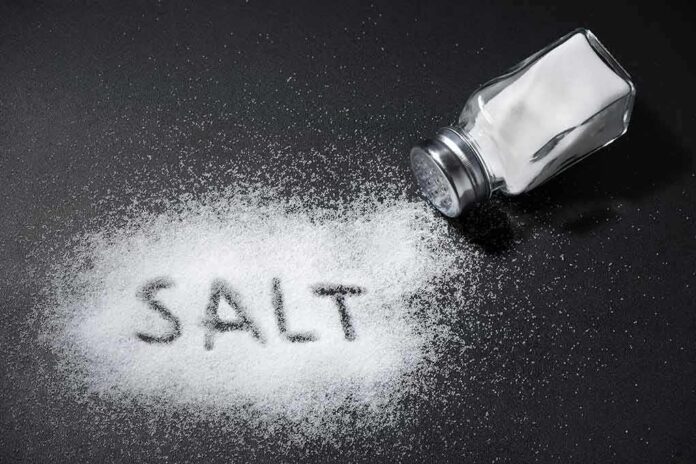
Swapping out a quarter of the salt in your kitchen for potassium chloride could cut your risk of stroke, heart disease, and early death — but doctors warn it can also turn deadly for the wrong patient.
Quick Take
- A massive trial of 600 Chinese villages found a potassium-enriched salt substitute lowered stroke risk by about 14% and cut early deaths by 12%
- The World Health Organization already recommends adults get more potassium through food to help control blood pressure
- Major kidney and heart groups warn the same potassium swap can cause dangerous heart rhythm problems in people with kidney disease or on certain blood pressure drugs
- Experts say the real gap in blood pressure guidelines is potassium, not just sodium, but nobody has written clear rules for who should try it
The Trial That Put Potassium On The Map
Researchers randomly assigned 600 rural Chinese villages to either regular salt or a blend that was 75% sodium chloride and 25% potassium chloride. The results, published in the New England Journal of Medicine, were striking: stroke rates dropped, major heart events fell, and fewer people died overall in villages using the potassium blend. The American College of Cardiology later broke down the numbers: 29.4 strokes per 100 person-years with the substitute versus 33.65 with regular salt.
That is not a small effect for something as cheap as changing what sits on the dinner table. The study tracked almost 21,000 people over several years, giving it real weight. But the trial mostly enrolled older adults and stroke survivors in rural China, so it does not automatically prove the same benefit applies to a 45-year-old in Ohio with no health problems.
Why Potassium Gets Ignored In The Sodium Conversation
For decades, blood pressure advice has focused almost entirely on cutting sodium. The World Health Organization says that misses half the picture. Its guidelines call for adults to get at least 3,510 milligrams of potassium a day from food, specifically because it lowers blood pressure and cuts stroke and heart disease risk. A separate trial in Peruvian villages found potassium-enriched salt cut the risk of developing high blood pressure in the first place by 51%.
The logic is simple. Sodium and potassium work like a seesaw inside the body. Pushing sodium down helps, but pulling potassium up helps too, and doing both at once may work better than either alone. That is the theory driving renewed interest in potassium-based salt substitutes as a cheap, scalable fix for a problem that kills more Americans than almost anything else.
The Catch Doctors Keep Repeating
Here is where the story gets complicated, and where caution matters. The National Kidney Foundation warns that potassium-containing salt substitutes can trigger life-threatening high potassium levels, known as hyperkalemia, in people who already struggle to clear potassium from their blood. The National Institutes of Health specifically flags people on ACE inhibitors, angiotensin-receptor blockers, and potassium-sparing diuretics, all common blood pressure medications, as being at higher risk.
The American Heart Association echoes that warning, telling people with kidney disorders to check with a doctor before touching potassium-rich salt substitutes. This is not a fringe concern. The original Chinese trial itself excluded anyone with chronic kidney disease or on potassium-affecting drugs, so its glowing safety record never actually tested those higher-risk groups. A review of 32 hypertension guidelines and 14 kidney guidelines found the recommendations on this topic are inconsistent and incomplete across the board, leaving both doctors and patients without clear direction.
Why Guidelines Still Lag Behind The Science
Clinical groups face a real bind. The 2017 heart association guideline backs potassium through diet unless a patient has kidney disease or takes potassium-retaining drugs, while British guidance from the National Institute for Health and Care Excellence tells older adults, diabetics, pregnant women, and kidney patients to avoid potassium chloride substitutes entirely. Every major systematic review behind these recommendations excluded people who could be harmed by extra potassium, so nobody has solid proof either way for those groups.
🧂 A Simple Salt Swap Cut Strokes by 14%
What if swapping the salt in your kitchen could lower your risk of stroke?
In a large trial led by researchers at The George Institute for Global Health, 600 villages in rural China were randomly assigned to use either regular salt or a… pic.twitter.com/BjMIW4TWRM
— BriteEnceladus (@BriteEnceladus) October 30, 2026
That gap matters because the people most likely to have high blood pressure in the first place, older Americans on multiple medications, are often the same people doctors say should be most careful with potassium salt. Taste is another hurdle. Potassium chloride can taste bitter or metallic, and food companies have little incentive to reformulate products if shoppers reject the flavor.
What Comes Next
This is a case where common sense beats hype. The evidence for potassium-enriched salt as a population-wide tool is real and worth taking seriously, especially for healthy adults without kidney problems. But anyone with kidney disease, diabetes, or who takes blood pressure medication should talk to a doctor before swapping salt, not take advice from a social media clip. Until researchers run trials that include higher-risk patients, the safest move is to treat potassium as a genuine piece of the puzzle, not a miracle fix that replaces medical judgment.
Sources:
nejm.org, acc.org, who.int, iris.who.int, academic.oup.com