

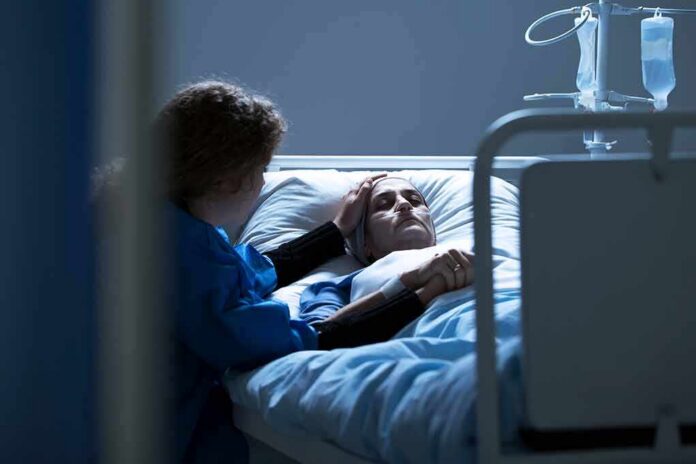
A cancer patient in Gloucestershire put on a headset and, for twenty minutes, stood inside Gloucester Cathedral without leaving her hospital bed.
Story Snapshot
- Gloucestershire hospitals are giving long-term patients virtual reality headsets to visit local landmarks like Gloucester Cathedral and Puzzlewood from their beds.
- Early results show the technology helps calm anxiety, and the trial has already expanded beyond its original oncology and critical care units.
- Hospital staff filmed the 360-degree footage voluntarily, on their own time, using their own initiative.
- No peer-reviewed clinical data exists yet, but patient responses have been strong enough to push the program wider.
What Gloucestershire Hospitals Are Actually Doing
The trial is live at both Gloucestershire Royal Hospital and Cheltenham General Hospital. Patients in oncology and critical care units get access to virtual reality (VR) headsets loaded with 360-degree video of local landmarks. The list includes Gloucester Cathedral, Puzzlewood, Symonds Yat, Dean Forest Railway, and Bristol Zoo Project. Patients slip on the headset and can look in every direction, as if they are actually standing there. Sessions run for about twenty minutes.
The idea came from the hospital’s patient experience team, not from a tech company or a research grant. That matters. It means the motivation was simple: patients stuck in beds for weeks or months were struggling, and staff wanted to help. Immersive Learning Technology Officer Stephen Lewis confirmed that staff went out and filmed the content themselves, on their own time, because they believed in it. That kind of grassroots commitment is hard to fake and harder to manufacture.
What Patients Are Actually Saying
Patient Tina Hunt described the effect plainly. She said being able to “transport yourself out of the hospital atmosphere into something enjoyable is beneficial.” That is not a clinical outcome measure. But it is real. Long-term hospital stays grind people down. The waiting, the noise, the smell, the loss of control — it adds up fast. A twenty-minute mental escape to a forest or a cathedral is not a cure, but it is not nothing either.
Sarah Kruk, from the hospital’s simulation and technology-enhanced learning team, said preliminary findings show the VR helps with “calming down” patients’ anxiety. Staff reported seeing smiles. Some patients cried. The emotional responses were strong enough that the trust extended the trial beyond oncology and critical care into other departments. Programs that produce tears and smiles in long-term patients do not get quietly shelved. They get expanded.
The Honest Gap in the Evidence
Here is where the story gets more complicated. There is no published peer-reviewed study behind this trial. No control group. No before-and-after anxiety scores using a validated scale. The trust has developed strict rules about which patients can safely use VR, which is responsible. But it also means the results so far come from a carefully selected group. Whether the benefits hold up across a broader patient population is still unknown.
That is not a reason to dismiss what is happening. It is a reason to push for proper research. The broader NHS has been testing VR in hospital settings for years. Medway Maritime Hospital used it during minor operations and reported lower anxiety and pain. A study on a neurorehabilitation unit found VR reduced both pain and anxiety scores, though the eligible patient pool was small. The pattern across these trials points in the same direction Gloucestershire is heading. The science just needs to catch up with the practice.
Why This Program Deserves More Attention Than It Is Getting
Coverage of this trial has stayed mostly local and regional. That is a missed opportunity. The National Health Service (NHS) spends enormous resources managing the psychological toll of long-term inpatient stays. Anxiety drives medication use. It slows recovery. It strains staff. A low-cost, non-drug intervention that patients actually want to use — filmed by volunteers on a weekend — deserves a serious national conversation, not just a regional news slot.
The next step is straightforward. Gloucestershire should commission a proper clinical trial. Measure anxiety before and after, using a validated tool. Track patients for weeks after the sessions end. Publish the results. If the data holds up, this becomes a model other NHS trusts can copy cheaply and quickly. If it does not, the hospital learns something valuable and adjusts. Either way, the patients sitting in those oncology wards right now do not need to wait for the journal article. The headsets are already there. The cathedral is already loaded. That part, at least, is already working.
Sources:
docs.google.com, linkedin.com, gloshospitals.nhs.uk, halldale.com, pubmed.ncbi.nlm.nih.gov