

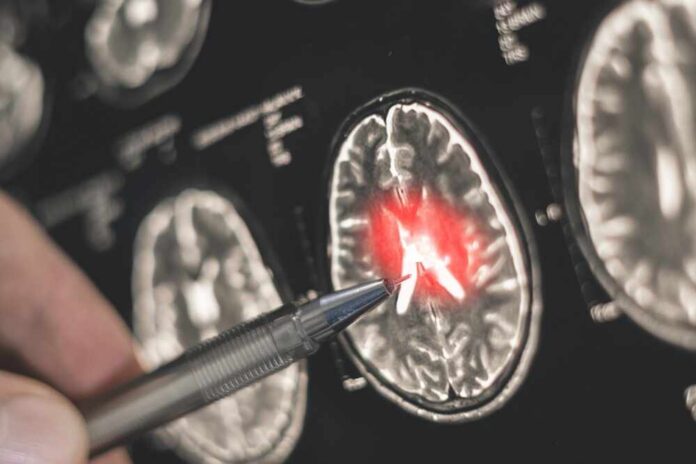
One obscure genetic typo in a glue-like blood protein may quietly cancel much of the Alzheimer’s risk carried by one of the scariest genes in medicine.
Story Snapshot
- A rare variant in the fibronectin 1 (FN1) gene slashes Alzheimer’s odds in people with two high‑risk APOE ε4 copies
- This single change appears to lower fibronectin buildup at the brain’s blood–brain barrier “filter,” improving waste clearance
- The same variant is linked to Alzheimer’s onset being delayed by around three to four years in carriers
- Researchers already eye fibronectin‑blocking drugs, while sober voices warn: powerful finding, very narrow, and far from a cure
A dangerous gene, a tiny minority who seem to dodge the bullet
Doctors have long told patients with two APOE ε4 gene copies that their Alzheimer’s risk is high and their odds of escaping dementia are low. Yet in the largest genetic databases, a puzzling minority of these “high‑risk” people reached old age with normal cognition. Researchers dug into their DNA and found a rare variant in the fibronectin 1 gene, called rs140926439, that kept showing up in these escapees.[1][2][3]
The team analyzed 7,185 people who all carried two APOE ε4 copies and found that those with the rs140926439 variant had roughly a 71 percent lower odds of Alzheimer’s, reflected in an odds ratio of 0.29.[1][2][3] That kind of effect size is enormous in human genetics, more like a seatbelt than a nudge. The same variant was linked to a later age of onset, delaying Alzheimer’s by about 3.4 years on average.[1][2][3]
Fibronectin and the brain’s clogged filter problem
Fibronectin 1 is a structural “glue” protein that helps form the extracellular matrix, the scaffold around cells and blood vessels.[4][5] In the brain’s blood–brain barrier, that matrix acts like a filter between blood and nerve tissue. The new research suggests that in APOE ε4 carriers without dementia, fibronectin does not pile up as much in blood–brain barrier vessel walls as it does in those who develop Alzheimer’s.[1][2][3]
Loss‑of‑function changes in fibronectin 1, including rs140926439, appear to reduce this vascular deposition and ease the traffic jam.[1][2][3] In experimental models, lowering fibronectin was associated with better “gliovascular” remodeling and less gliosis, the inflammatory activation of supporting brain cells.[1][2][3] Alzheimer’s is not just about plaques, but also about failing maintenance systems and vascular health that big bureaucracies ignored for decades.
From rare genetic shield to possible drugs, and the danger of hype
Drug‑development groups have already flagged fibronectin 1 as a potential target, arguing that if nature grants a protective loss‑of‑function variant, then a well‑designed inhibitor might mimic that effect.[5] Their briefing notes that brain tissue from APOE ε4 carriers with rs140926439 shows less fibronectin at the blood–brain barrier and less reactive gliosis, a tantalizing proof of concept that a single pathway might modulate both vascular and inflammatory damage.[5]
Methodical reviewers, however, stress just how rare this variant is and how wide the confidence intervals around that 71 percent risk reduction remain.[1][2][3][5] The original study itself reports a confidence interval from 0.11 to 0.78 for the odds ratio and more than a five‑year spread in the age‑delay estimate, which signals real uncertainty about the exact size of the effect.[1][2][3] That is why responsible institutions, including Mayo Clinic, pair their excitement about a protective fibronectin variant with the plain statement that more research is needed.[6]
What this means for everyday risk and responsibility
This protective fibronectin variant does not overturn the basic facts: most Alzheimer’s cases arise from a messy mix of genes, age, vascular health, and lifestyle choices. Mayo Clinic reminds patients that even strong genetic signals like APOE ε4 and fibronectin 1 do not work in isolation and that non‑genetic factors still powerfully shape risk.[6]
Genetic discoveries like rs140926439 are best seen as flashlights, not crystal balls. They illuminate a vulnerable system—the brain’s barrier and cleaning network—and point toward targeted interventions that could help many people, not just the tiny fraction who won the genetic lottery.[1][2][3][5] The risk is that media and speculative investors inflate a rare variant into a miracle shield, while the harder work of replication, mechanism testing, and practical prevention quietly decides whether this finding truly changes the Alzheimer’s story.
Sources:
[1] Web – Scientists identify gene variant that may protect against APOE ε4 …
[2] Web – Newly Found Genetic Variant Defends Against Alzheimer’s Disease
[3] Web – Rare genetic variation in fibronectin 1 (FN1) protects against …
[4] Web – Rare genetic variation in fibronectin 1 (FN1) protects against … – …
[5] Web – [PDF] Fibronectin-1 Inhibitors – Alzheimer’s Drug Discovery Foundation
[6] Web – Alzheimer’s genes: Are you at risk? – Mayo Clinic